Selling roasted coffee online is not just about getting a customer to place one order. Your real win comes when that first bag turns into a second, then a third, then a subscription that feels easy, useful, and worth keeping.
That shift does not happen by accident. You need a store that removes doubt, product pages that answer buying questions fast, and follow-up marketing that shows up at the right moment. When you put those pieces together, your eCommerce site stops acting like a catalog and starts acting like a sales system.
Start with the first order, but plan for the fifth
A lot of coffee brands focus hard on acquisition and then ease up after checkout. That leaves money on the table. A first-time buyer is rarely fully loyal yet. They are still testing your roast quality, shipping speed, freshness, packaging, and service.
Your strategy should treat the first order as the start of a relationship. That means every touchpoint after purchase should answer one quiet question: “Why should I buy my next bag from you instead of someone else?”
You do not need a huge funnel to make this work. You need the right sequence.
| Stage | What your customer wants | What your store should do |
|---|---|---|
| First visit | Quick clarity | Show roast types, flavor notes, brew fit, and pricing fast |
| Product view | Confidence | Display roast date, grind options, reviews, and shipping details |
| Checkout | Low friction | Keep forms short, allow guest checkout, show trust signals |
| Post-purchase | Reassurance | Confirm order details, set expectations, suggest next best product |
| Reorder window | Convenience | Send reminders, make repeat purchase one click, offer subscription |
| Subscription phase | Control | Let customers skip, swap, pause, and edit without contacting support |
That table may look simple, but it reflects a bigger truth: coffee buyers reward clarity. If your site feels clean, fast, and honest, conversion gets easier.
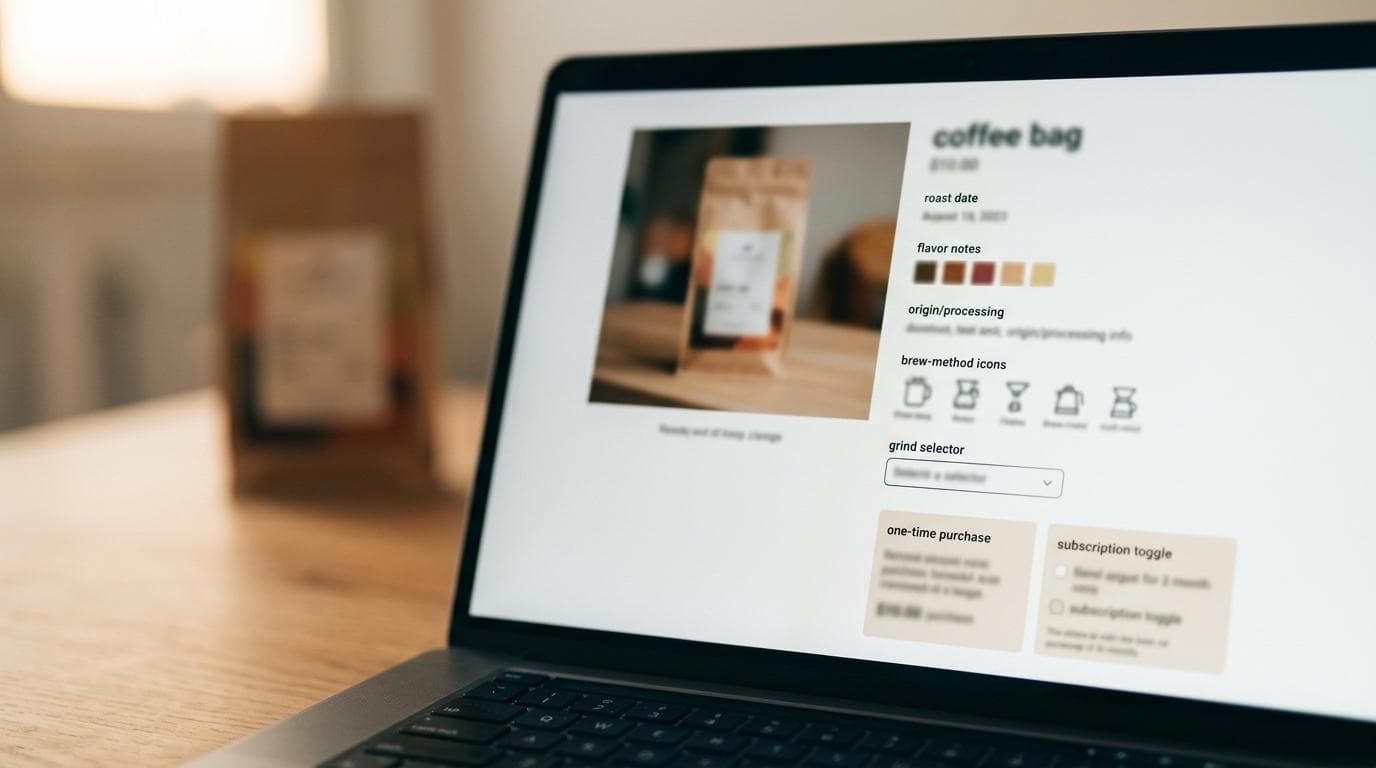
Build product pages that answer buying questions fast
Coffee is sensory, but your website has to sell it through words, images, and structure. If a shopper lands on a product page and still has to guess what the coffee tastes like, how fresh it is, or whether it fits their brew method, they are more likely to leave.
Your product pages should do more than show a bag and a price. They should reduce hesitation.
After you explain the coffee clearly, make the buying path obvious:
- Roast date
- Flavor notes
- Origin and processing
- Brew method guidance
- Whole bean or grind choice
- One-time purchase and subscription side by side
That last point matters a lot. If you hide the subscription option until late in the process, you miss customers who are already open to repeat delivery. Put the choice on the product page, but keep it plain. Say what they save. Say when it ships. Say that it renews. Say they can change it later.
Clear subscription copy beats clever copy every time.
Make subscription the natural next step
Many coffee brands push subscriptions too hard, too early, or too vaguely. That creates resistance. People do not mind recurring orders when the offer feels fair and flexible. They mind surprises.
Your best move is to present subscription as a better version of a normal order, not a trap with a discount attached. Show the savings, show the delivery schedule, and show the customer controls right away. If you can say “save 10%, edit anytime, skip whenever you want,” you remove a lot of fear in one sentence.
This is also where your site experience matters more than your coupon. A clean page, a visible subscription toggle, and a short explanation often outperform a louder offer on a cluttered layout.
A strong subscription offer usually includes three things:
- Savings: a clear price difference from one-time purchase
- Flexibility: weekly, biweekly, or monthly options
- Control: skip, pause, swap coffee, or cancel without friction
If your subscription terms sit in tiny text below the add-to-cart button, fix that first. Transparency helps conversion and lowers churn later.
Email is where repeat revenue gets built
Email still gives coffee roasters one of the best returns in eCommerce, especially once someone has already purchased. Triggered flows can drive a meaningful share of online revenue, and abandoned cart emails alone can recover a solid chunk of lost orders.
That matters because coffee is naturally reorder-friendly. You already sell a product people consume and replace. Your email program should act like a smart reorder engine, not just a monthly newsletter.
A basic setup can go a long way. You do not need dozens of automations on day one. You do need the right ones, written with good timing and a clear offer.
After your first order comes in, focus on messages like these:
- Welcome flow: set expectations, introduce your bestsellers, and explain what makes your roast different
- Post-purchase follow-up: ask how the coffee is landing, suggest brewing tips, and offer a subscription on the next order
- Cart recovery: remind visitors what they left behind and keep the path back short
- Reorder reminder: hit the likely refill window before they run out
- Subscriber retention: highlight account controls, new releases, and easy add-ons
Triggered emails often outperform broad campaigns because they match customer behavior. A buyer who just ordered espresso wants something different from a visitor who abandoned a cart with a single origin filter roast. Segment accordingly.
Educational content also belongs here. Brew guides, origin stories, roast profiles, and freshness tips help justify your price and build trust. Research shows content influences purchase decisions, and coffee buyers tend to reward brands that teach without talking down to them.
SEO, social, and paid ads each have a different job
You should not expect every channel to do the same work. Organic search, social media, and paid ads support different parts of the sales cycle.
Organic search is powerful because it catches intent. A shopper looking for “single origin coffee beans” or “best espresso beans online” is already in buying mode. Across eCommerce, organic search drives a large share of traffic and a meaningful share of orders. If your category pages, product pages, and educational articles are optimized well, you give yourself a steady source of traffic that does not disappear the moment ad spend slows down.
Social media does something else. It builds familiarity, taste, and identity. Coffee is highly visual, so behind-the-scenes roasting clips, brew recipes, customer photos, and short education posts can make your brand feel alive. That makes later conversion easier.
Paid ads help you speed up demand capture. Search ads can target high-intent buyers. Social ads can retarget visitors who looked at products but did not convert. If your landing pages are strong, those campaigns can produce efficient growth.
The mistake is sending all traffic to weak pages.
A few channel rules will keep your budget sharper:
- SEO: target product intent keywords and publish supporting content that answers real buying questions
- Paid search: send traffic to specific product or collection pages, not your homepage
- Retargeting: remind visitors about the exact coffee they viewed or the subscription they considered
- Social content: show the product in use, not just in packaging
If more than 70% of your traffic is mobile, and for many stores it is, your pages need to load fast and read cleanly on a phone. Otherwise, your acquisition strategy leaks before checkout even starts.
Loyalty should start before subscription
You do not need to force every first-time buyer into a subscription on day one. Some people want to sample, compare, and build confidence first. That is normal. A loyalty program gives you a middle step between one-off purchase and recurring commitment.
This matters because returning customers usually spend more than new ones. Once someone trusts your roast and your service, the economics improve fast. Loyalty gives you a reason to keep the conversation going.
You can keep it simple:
- Points for every order
- Referral credit
- Early access to limited releases
- Bonus points on a second purchase
- Subscriber-only gifts or add-ons
Referrals deserve special attention. Coffee is social. People share favorite beans, brew setups, and cafe finds all the time. When you reward that behavior, you turn happy customers into a lower-cost acquisition channel.
The best loyalty systems feel connected to your brand, not copied from a plugin demo. If your coffee story centers on seasonal lots, education, or membership perks, your rewards should reflect that.
Retention improves when control is obvious
A subscription becomes fragile when customers feel stuck. Retention gets better when buyers feel in control of timing, taste, and spend.
That means your subscriber portal should be easy to find and easy to use. Let people skip the next shipment. Let them swap coffees. Let them adjust grind type or frequency. Let them pause during travel or tighter months. If support has to step in for every small edit, you create friction that turns into cancellations.
Poor experience drives churn more often than price alone. When someone cancels, it is often because something felt confusing, inconvenient, or ignored.
You can cut churn by making these fixes visible:
- Account access: put subscription management in plain sight
- Preference editing: allow swaps for roast, grind, and cadence
- Support access: offer a fast contact path when something goes wrong
- Feedback loop: ask why people cancel and use that data
This is one reason many coffee-focused eCommerce builds prioritize ownership-minded systems, flexible subscription tools, and clear UX instead of flashy features. Agencies that work closely with coffee roasters, including Wapiti Digital, often focus on those fundamentals because they directly affect conversion, repeat orders, and recurring revenue.
What to fix first if your store feels stuck
If your online sales are steady but subscriptions lag, you probably do not need a full reset. You need to tighten the points where customers hesitate.
Start with these three moves:
- Put one-time purchase and subscription on the same product page, with plain-language terms and visible savings.
- Build or improve your post-purchase and reorder email flows.
- Make your mobile product pages faster, cleaner, and easier to scan.
Then look at your metrics with discipline. Watch conversion rate by device, repeat purchase rate, subscription take rate, email recovery from abandoned carts, and churn by month. Those numbers tell you where the system is weak.
Coffee eCommerce works best when every step feels easy: first click, first bag, second order, long-term subscription. When your site, emails, content, and retention tools all support that path, you stop chasing one-off sales and start building a customer base that comes back on purpose.