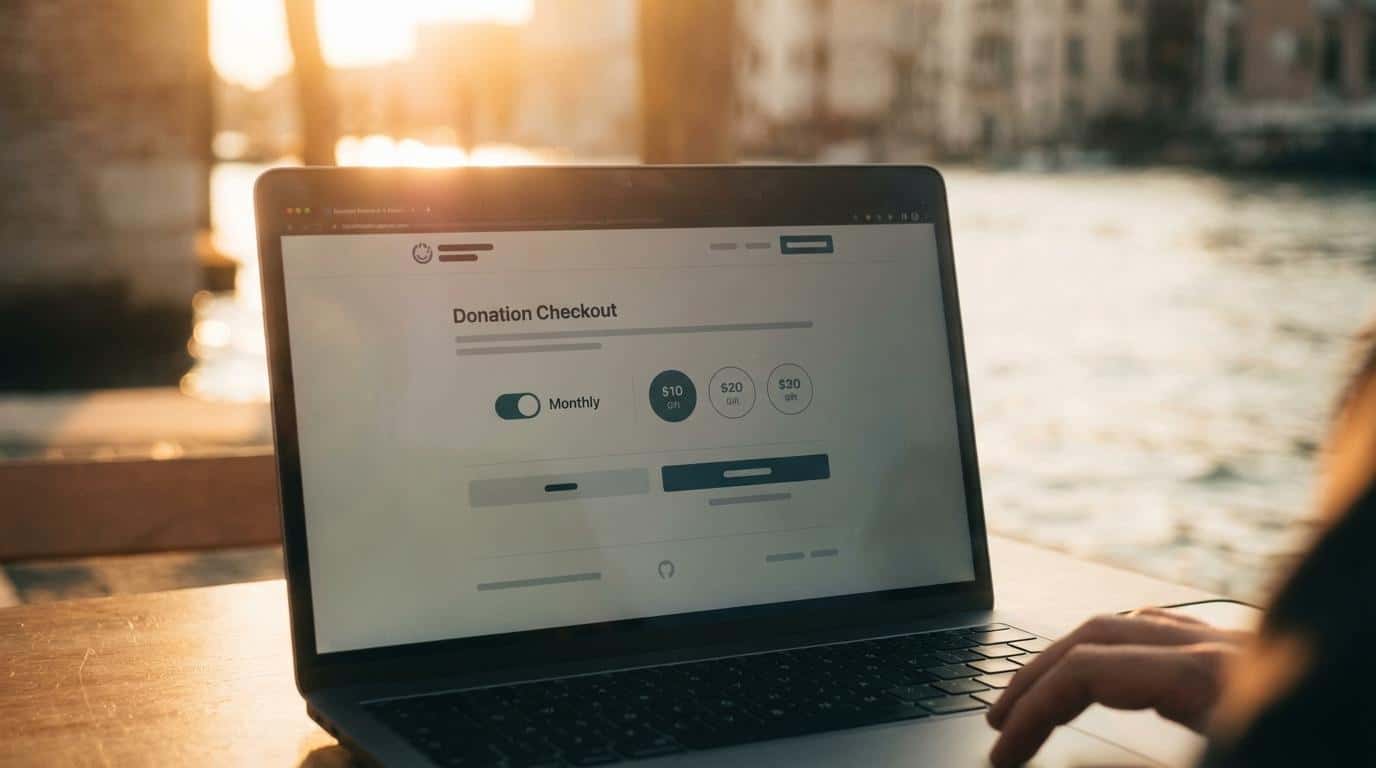
A donation funnel that scales is not just a nicer donate page. It is a full system that moves a supporter from curiosity to trust, from trust to action, and from a single gift to an ongoing commitment.
If you want more recurring donors, you need to stop treating monthly giving as a separate campaign that appears once or twice a year. It should be built into your website, your messaging, your follow-up, and your reporting from the start.
That shift changes everything. Instead of asking, “How do you get more gifts this month?” you start asking, “How do you help the right people become long-term supporters?”
Start with the donor, not the form
Your supporters do not experience your fundraising in departmental pieces. They do not think in terms of homepage, campaign page, donation form, CRM, and thank-you automation. They experience one path, and they decide very quickly whether that path feels clear, credible, and worth their time.
That means your funnel needs to answer a simple set of questions in order. Why does this matter? Why should you trust this organization? What difference will your gift make? Why give now? Why give again?
When those answers are scattered, your funnel leaks. When they are connected, your funnel compounds.
A scalable donation funnel usually has five stages: awareness, engagement, consideration, conversion, and retention. You do not need a complicated diagram to make this work, but you do need a site and follow-up system that respects each stage.
What a healthy donation funnel looks like
A strong funnel guides a visitor forward without forcing them. Someone may first meet your mission through search, social media, email, a referral, or a campaign page. From there, they should be able to move naturally into stories, proof, impact details, and a donation experience that feels easy on any device.
Recurring giving should not be hidden at the last second. It should appear as a natural next step throughout the experience, especially for donors who already show interest and trust.
| Funnel stage | What your supporter needs | What your site should do |
|---|---|---|
| Awareness | A clear mission and reason to care | State your purpose quickly and show real impact |
| Engagement | Stories, proof, and relevance | Offer program pages, stories, stats, FAQs, and email sign-up |
| Consideration | Confidence and clarity | Show trust signals, outcomes, financial transparency, and giving options |
| Conversion | A fast, easy action | Use a simple form, smart gift amounts, mobile-friendly payments, and a visible monthly option |
| Retention | Gratitude and connection | Send prompt thanks, impact updates, and recurring donor welcome content |
When you build each stage intentionally, monthly giving feels like a continuation of the relationship, not a surprise upsell.
The best time to introduce recurring giving
Many nonprofits wait too long to ask for monthly support. They assume a first-time donor needs months of cultivation before that option makes sense. In reality, some supporters are ready right away if the value is clear and the choice is presented well.
That does not mean you pressure every donor into a subscription. It means you frame recurring giving as the most practical way to make steady impact. A one-time gift can feel generous. A monthly gift can feel purposeful, dependable, and identity-driven.
Naming your recurring program can help. It gives people something to join instead of just another billing arrangement. This works especially well when the message is tied to mission, community, and outcomes rather than perks alone.
You will usually see the best results when you tailor the ask by donor type.
- First-time donor: Welcome them warmly and show what their first gift made possible.
- Recent one-time donor: Invite them to turn a moment of support into ongoing impact.
- Repeat donor: Position monthly giving as the easiest way to stay consistent.
- Current recurring donor: Reinforce identity, gratitude, and long-term value.
A donor who gave once last week should not receive the same appeal as someone who has made three gifts this year. Your funnel scales when your messaging becomes more relevant.
Small design choices can change results fast
You do not need a dramatic redesign to improve donor conversion. You do need fewer points of friction.
The donate button should be easy to find across your site. The donation page should feel focused, not crowded. The form should ask only for what you truly need. And the monthly option should be visible without making supporters work to find it.
Payment flexibility matters too. If your form only supports one method, you create unnecessary drop-off. Credit cards, digital wallets, and familiar payment tools reduce hesitation and help mobile donors finish the process.
Accessibility is part of conversion, not an optional extra. High contrast text, keyboard-friendly forms, clear labels, readable layouts, and responsive mobile design all increase completion rates while serving more people well.
The highest-impact improvements are often simple:
- Clear donate buttons
- Fewer form fields
- Mobile-first layout
- Suggested giving amounts
- Impact language beside each amount
- Visible recurring option
- Multiple payment methods
If your donation form feels harder than an online purchase, your funnel is underperforming.
Make monthly giving feel concrete
People commit more easily when they can picture the effect of their support. “Give monthly” is abstract. “Provide weekly meals all year” is not.
This is where framing matters. A recurring gift should feel like a practical tool for steady impact, not just a smaller version of a larger one-time gift. You want supporters to see the rhythm of what their giving sustains.
A few message patterns tend to work well:
- Impact framing: $15 a month helps fund supplies every single week.
- Stability framing: Monthly donors help your team plan services with confidence.
- Identity framing: Join a committed group of supporters who keep this work moving every month.
- Ease framing: Set it once, support all year, and update anytime.
You can reinforce this on the form itself with suggested amounts and plain-language descriptions. If allowed in your setup and local compliance context, a smart recurring default can also help. The key is transparency. Donors should always know exactly what they are agreeing to.
Stewardship is not aftercare
Too many nonprofits treat stewardship like a polite thank-you after the real work is done. In a scalable funnel, stewardship is part of conversion. It is what turns a gift into trust and trust into retention.
A donor who gives online should receive a prompt acknowledgment that feels human, specific, and reassuring. Generic receipts are not enough. Your thank-you should confirm the gift, reflect the donor’s action, and connect that action to impact.
That first message should not rush into another ask.
Then your follow-up should continue the story. Show what changed. Share one meaningful update. Introduce the people, programs, or outcomes behind the mission. If the donor joined a monthly program, give them a dedicated welcome sequence so they feel recognized from day one.
Strong stewardship often includes a mix of touchpoints over time:
- Immediate thanks: Confirm the gift and connect it to real work
- Early follow-up: Share a story, photo, or short update within days
- Ongoing reporting: Send regular impact updates that are easy to scan
- Personal recognition: Use calls, notes, or anniversary messages for key moments
This is not about volume. It is about relevance and timing. A supporter who feels seen is much more likely to keep giving.
Your technology should support the relationship
A scalable donation funnel depends on connected systems. If your website, payment platform, donor database, and email tool are all isolated, your staff spends time patching gaps instead of building momentum.
You need forms that are easy to manage, recurring billing that works reliably, donor records that stay accurate, and automation that responds to behavior without feeling robotic. When those pieces connect well, you can segment donors, personalize outreach, and spot drop-off points before they become bigger revenue problems.
This is where a custom website and platform setup can make a real difference. If your donation experience is built around your actual donor journey, rather than forced into a generic template, you gain more control over conversion, reporting, and recurring revenue.
For nonprofits, membership groups, and mission-driven organizations, that matters. A website should not just explain your mission. It should actively support giving, communication, and retention.
Measure what makes growth sustainable
You cannot scale what you do not track. Vanity metrics may look encouraging, but recurring giving grows when you focus on behavior and retention.
Traffic matters. Click-through rates matter. Still, the numbers that shape long-term revenue are the ones tied to donor commitment and donor value.
Keep your reporting focused on a small set of decision-making metrics.
- Recurring donor count: How many active monthly donors you have right now
- Recurring conversion rate: How many one-time donors become recurring donors
- Churn rate: How many recurring donors cancel or lapse over time
- Average monthly gift: The typical recurring amount across active supporters
- Lifetime value: The long-term revenue generated by a donor relationship
- Form completion rate: How many visitors start the form and actually finish it
Watch those metrics monthly. If form completion is weak, simplify the page. If churn rises after a few months, improve your welcome sequence and donor updates. If recurring conversion is flat, revisit how and when you present the monthly option.
You do not need perfect data to improve your funnel. You need useful data and the discipline to act on it.
Build for the next gift while earning this one
The strongest donation funnels do two jobs at once. They make it easy for someone to give today, and they prepare that person to give again without friction or confusion.
That is the real shift from one-time fundraising to scalable recurring revenue. You stop relying on repeated urgency alone and start building a system that earns trust, reinforces impact, and makes continued support feel natural.
When your message is clear, your form is simple, your follow-up is thoughtful, and your systems are connected, recurring giving stops feeling unpredictable. It becomes something you can intentionally grow.